
The alarm goes off. Maybe you hit snooze, maybe you get right up, but for many of us, that choice doesn’t stop the morning from getting away from us. We’re juggling kids, pets, household chores, packing lunches, and it seems like there’s no time for a proper breakfast.
Instead, we grab a bagel, some toast, or maybe a piece of fruit because it seems healthy. At least we’re eating, right? While breakfast is an important way to literally break our overnight fast and get our bodies moving again, protein at breakfast is often overlooked, and when it comes to nutrition, this is a missed opportunity.
Quick Links:
- Why Protein At Breakfast Matters
- How Much Protein At Breakfast Should You Eat?
- 5 Easy Ways to Get More Protein at Breakfast
- High-Protein Breakfast Ideas for Busy Mornings
- Can You Get a High-Protein Breakfast on the Go?
- How to Get More Protein In Your Diet Beyond Breakfast
- When to Ask Your Doctor About Protein Intake
 Why Protein At Breakfast Matters
You’ve likely heard that breakfast is the most important meal of the day, but did you know that what you eat for breakfast matters too? Visiting any breakfast buffet, or even most homes, you’d erroneously believe that carbohydrates are the most important part of breakfast, but the truth is that adding protein at breakfast supports muscle maintenance, recovery, and energy, as well as helping to stabilize blood sugar levels.
Beyond the muscle benefits, protein at breakfast can also help you feel full longer and reduce food cravings. In one study of adolescents, protein at breakfast also reduced evening snacking (for young women who regularly skip breakfast).
Many of us load our protein at lunch, or more often dinner, where we meal plan around lean meats or other proteins. However, research suggests that spreading protein across our meals, throughout the day, can produce nearly 25% more muscle protein synthesis over 24 hours than eating the same amount of protein in a single meal.
This doesn’t mean you need to skip your morning toast in favor of a protein-heavy breakfast, but it does suggest that adding a meaningful amount of protein to your normal morning meal may be very beneficial.
How Much Protein At Breakfast Should You Eat?
This is, almost always, the next question folks ask. How much protein should I add in? The truth is, there’s no single answer, no amount that’s appropriate for everyone. In fact, protein needs depend largely on your body size, age, activity level, health, and your goals.
However, research across multiple demographics suggests that 20-40 grams of protein is appropriate for most adults. For older adults, research suggests 30 grams of protein. For most, the formula is somewhere between 0.25 and 0.4 grams per kilogram (weight) per meal, with 0.4 grams noted for adults over 50 in one study.
While there is no “magic” number for protein intake, research has proven that more is not necessarily better. One British study found that 34 grams of protein improved how full participants felt, more than a 6-gram breakfast, but didn’t improve other biometrics over the 3-month study.
The bottom line is to aim for 20-30 grams at breakfast, but what you eat during your other meals or throughout the day still matters.
 5 Easy Ways to Get More Protein at Breakfast
One of the biggest struggles to adding more protein at breakfast, for many of us, is the time crunch. In the morning, we’re getting ourselves ready for our day, possibly helping kids get ready, taking care of animals, and generally rushing through our morning routines. Who has time to cook a full breakfast?
The good news is, protein need not be complicated, but it might take some prep. That said, here are 5 easy ways to get more protein at breakfast:
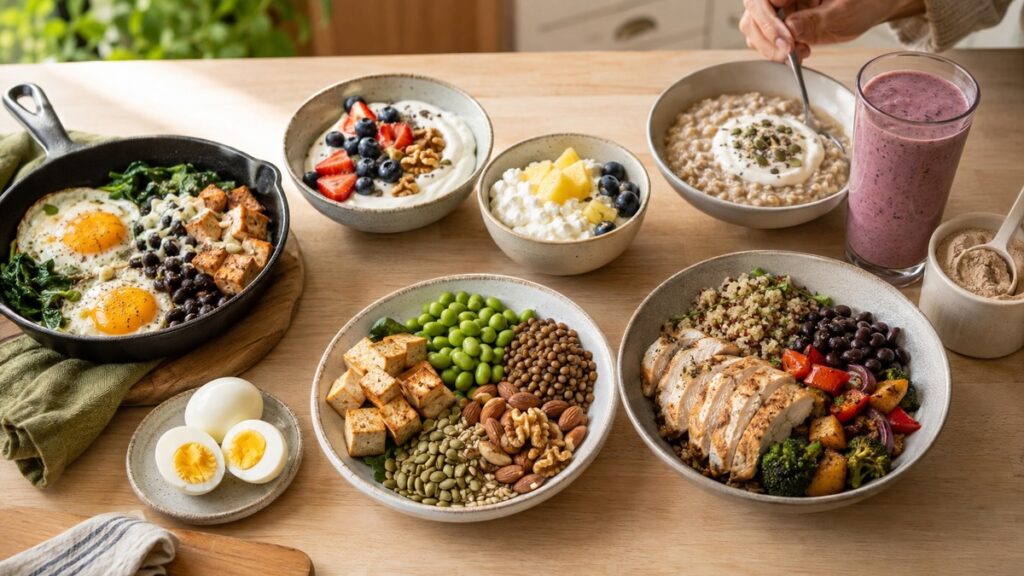
1. Eggs. There are about 6-7 grams of protein in an egg. Whether you opt for hard-boiled or combine them with beans, cheese, salmon, tofu, or sausage, a quick breakfast skillet (which can be made ahead of time) is a great way to boost protein at breakfast.
2. Greek yogurt and cottage cheese. Greek yogurt is high in protein, sometimes as much as 20g. Cottage cheese is similar, with approximately 20-25 grams per cup. Add in some fruit, nuts, or seeds to boost fiber, and you’ve got a great start!
3. Add protein to your regular breakfast. This is super easy if your go-to breakfast is oatmeal or smoothies. Swap water in oatmeal for dairy or protein-rich milk. Toss in some Greek yogurt or protein powder, and you’ve already likely hit protein goals. The same is true for smoothies.
4. Swap in plant-based proteins. Tofu, lentils, beans, nuts and seeds, edamame, nut yogurts, and even egg substitutes can help you add protein to breakfast without increasing meat or dairy.
5. Leftovers. You’ve heard of breakfast for dinner (brinner), but what about dinner at breakfast? Some of us have to go back to our younger days of leftover pizza and more for the last time we had dinner at breakfast, but there’s nothing that says breakfast must be cereal and eggs. Leftover lean meats like chicken or fish, quinoa, beans, and more can make a great (and easy) breakfast bowl or scramble, especially if you’re in a rush.
The truth is, adding extra protein can be as easy as adding a protein powder to your regular breakfast. It doesn’t need to be time-consuming or involve a lot of prep, especially if you have leftovers you can include.
High-Protein Breakfast Ideas for Busy Mornings
If your morning is busy, includes feeding or caring for multiple people (or animals), or is generally just a time crunch (maybe you’re a fan of the snooze button), then these ideas may work for you:
1. Greek yogurt parfait. Grab a ball jar or similar container and mix Greek yogurt with berries, nuts, and seeds. Toss it in the fridge to grab it quickly the next morning.
2. Egg bites. These are easiest in a muffin tin or pan. Mix eggs with vegetables, cheese, or lean meats and bake. These also freeze well, but will keep for a week of breakfasts in your refrigerator.
3. Protein smoothies. If you’ve got time to run the blender in the morning, then prepping and portioning out your ingredients the night before is a great option. Consider milk/soy/nut milk, protein powders or Greek yogurt, frozen fruits, peanut/almond/cashew butter, and some veggies like spinach.
4. Overnight oats. These are super easy to make the night before. Add your oats to your preferred milk, add chia seeds, hemp, or nut butter, and let it soften overnight in the fridge. Grab and go in the morning!
5. Breakfast wrap. Another freezer gem. Fill your favorite wrap (whole-grain) with eggs/tofu, beans, cheese, and some chopped veggies. Roll and wrap for freezing and reheat in the morning in a skillet or microwave.
While this does take time, setting aside a prep day for meals and making breakfast in advance is a great way to stay on top of your protein and nutrition goals. The best part here is that you can combine this prep with dinner prep. Burritos for dinner? Prep extra for breakfast!
 Can You Get a High-Protein Breakfast on the Go?
Some weeks, some mornings, are just next to impossible. We’re lucky we get out the door at all, let alone on time, or with time to make or grab breakfast. That doesn’t mean you have to skip your protein at breakfast.
Whether you’re rushed in the morning or just don’t like to cook, there are restaurant options that will meet your goals without necessarily adding in extra calories, sugar, or saturated fats. Eggs, lean meats, yogurt, and whole grains are all available at restaurants, even those with a drive-through!
Caveat: These options are intended for an on-the-go situation rather than as part of your daily diet. The information below refers only to the protein value and does not consider other nutrients, nor does it consider other dietary needs. Individuals watching calories, fats, sodium, cholesterol, or other dietary needs should be mindful, review nutritional information, and opt for choices that meet those needs.
- Starbucks Spinach, Feta & Egg White Wrap. These pack 20 grams of protein! The turkey bacon, cheddar, and egg white sandwich also has 17 grams of protein.
- Panera Garden Avo & Egg White Sandwich. Served on multi-grain bread, this breakfast sandwich is 19 grams of protein and 5 grams of fiber.
- Chick-fil-A Egg White Grill. Skip this if you’re watching your sodium, but with 300 calories, this breakfast sandwich has 27 grams of protein. With nearly 1000 mgs of sodium, this should be a last resort for those watching heart health. Just goes to show that not all items marketed as healthier options on fast food menus are a good option for everyone.
- McDonald’s Egg McMuffin. An old standby for many, but skip the hash brown and soft drink. 310 calories and 17 grams of protein. Add some fruit or yogurt to round this out.
- Einstein Bros. Garden Avocado Egg White Sandwich. This is good if you’re in a pinch, but at 450 calories and 860 mg of sodium, this is the best alternative to the options with meat or cheese, which often add more sodium, calories, and fat. This has 18 grams of protein and 5 grams of fiber, and it includes vegetables like spinach, tomato, and avocado.
It’s inadvisable, in any scenario, to build your diet around fast-food options, but sometimes, when we’re really in a rush or in a pinch, there are options. For those monitoring sodium or other nutrients, be sure to read the nutritional information. Just because something is labeled as a healthier option, it doesn’t make it healthy. That said, if you’re looking for protein on the go, options exist.
How to Get More Protein In Your Diet Beyond Breakfast
As the research above noted, breakfast is only part of the protein plan. Aiming for 20-40 grams of protein each meal, depending on your individual needs, means you’ve got to plan beyond breakfast as well.
If you struggle to prep breakfast, then spreading protein throughout the day is a better option than trying to get it all in at dinner. The easiest way to do this is to build your meals around protein, including fish, poultry, eggs, lean meats, tofu, beans, tempeh, edamame, and cottage cheese.
For the grazers or the small meal folks, this might also mean including protein-rich snacks like celery or an apple with nut butters, veggies and hummus, Greek yogurt, hard-boiled eggs, cheese and nuts, or even roasted chickpeas.
Protein powders are a great option to add to smoothies, but should be viewed as a supplement, not a meal replacement.
The key piece here is to adjust where you can and add in what you enjoy. You don’t need to change your entire diet, but instead make small tweaks like adding beans to soups and salads, which make them a bit heartier. Mix lentils into rice and quinoa dishes or swap milks for water in recipes (where that’s an option).
If you can, consistently add protein to your meals, you will leave room for vegetables, fruit, whole grains, and the other nutrients your body needs.
When to Ask Your Doctor About Protein Intake
As we mentioned above, protein needs are personal. Not everyone needs the same amount, and several factors may influence your needs. Further, over your lifetime, your needs will change. That’s what makes talking protein with your doctor important, especially if you’re pregnant, active or an athlete, over 50, in recovery after surgery or a major illness, experiencing unintended weight loss, or struggling to maintain muscle mass.
That said, if you have liver or kidney issues, diabetes, digestive concerns, food allergies, or dietary restrictions, professional help may be advisable, as any of these can impact your ability to get or absorb protein effectively.
If you’re experiencing fatigue, not feeling satiated after eating, are vegetarian or vegan, or are considering protein supplements or a high-protein diet, it may also be best to consult with a doctor or healthcare provider. While it may not mean you need more protein, it may be time to analyze your diet along with other lifestyle factors like symptoms, health history, activity levels, medications, and lab tests.
Your diet plays an integral role in your health, and while grabbing food on the go may work temporarily, long-term health relies on nutrition and a nutrient-dense diet that includes protein. If you’re concerned about your diet, or simply wondering how your nutrition may be impacting your health, it may be time to talk to someone.
At Canby Clinic, our naturopathic doctors are here with a deep understanding of the role your diet plays in your overall health. This is a core component of naturopathic medicine and care. If you’d like to open or continue the conversation, please reach out to our team for an appointment or consultation.
We’re here for practical guidance, tailored to your needs, health history, and health goals. Reach out to our team today!