
How many of you have stared at a collection of bottles on your kitchen counter or in a cupboard and wondered, “Is this even doing anything (or am I just paying for expensive poop)?”
Maybe your friend, mother, or spouse swears by the multivitamin they take, but is it right for you?
What we’re about to discuss will cut through the noise, hype, and mystery around multivitamins!
Quick Links:
- What Is a Multivitamin?
- Do Multivitamins Work?
- What a Multivitamin Can, and Cannot, Do</strong>
- Should I Take a Multivitamin?
- What Vitamins Should I Take?
- How to Choose the Right Multivitamin
- Does Age Change the Multivitamin You Need?
- Choosing a Multivitamin That Works for You (+ some recommendations!)
What Is a Multivitamin?
Multivitamins combine multiple vitamins and minerals into a single pill, tablet, liquid, powder, or gummy to fill nutritional gaps or deficiencies.
Multivitamins are intended as supplements, meaning a person’s diet does not or cannot meet all nutritional needs and a multivitamin helps to fill the gaps created by the limitations in the diet.
For people with varied needs and nutritional deficiencies, a multivitamin can replace multiple pills and, generally, simplify getting what you need.
Do Multivitamins Work?
This is a loaded question because so many variables matter, including the vitamin you choose and your unique nutritional needs.
Multivitamins are designed to fill nutritional gaps when food and diet don’t meet an individual’s needs. However, as noted above, vitamin formulas vary, and an individual’s needs vary based on factors including age, gender, health status, medication load, digestive function, genetics, and diet.
Multivitamins are not a magic pill. They can’t make up for a bad diet or poor nutrition. So, when we ask “do they work?” the real question is what do we mean by “work.”
If you expect a multivitamin to do some heavy lifting, including preventing disease and extending a person’s life, well, the evidence is less convincing. National Institutes of Health (NIH) research found that a multivitamin won’t necessarily lower your risk of death, especially when it comes to diseases like cancer or cardiovascular disease.
Yet randomized controlled trials show that multivitamins and supplements can improve cognition and blood pressure and help defend against infections.
The truth is, much like your naturopathic doctor would advise, research suggests that multivitamins, a healthy diet, and personalized nutrition, when taken together, promote healthy aging and longevity.
Vitamins aren’t a magic pill, but when paired with other healthy habits, they can show benefits, especially when you have nutritional deficiencies or gaps.
What a Multivitamin Can, and Cannot, Do
So if we move away from the language of “does this work or not?” we can look more closely at what it can do. Where can it benefit me? And how can I manage my expectations around adding in a multivitamin?
We’ve already discussed that it’s not a magic pill. It won’t fix everything or make up for years of nutritional neglect, but if you’re working on improving your diet and adding more nutrient-dense meals, a multivitamin can support that.
A multivitamin can:
- Fill gaps when you get too little of certain vitamins or minerals from your regular diet
- Make up for deficiencies created by restricted diets or life stages
- Help you get multiple nutrients in one pill rather than a shelf full of pill bottles and a handful of pills
A multivitamin cannot:
- Replace the nutrients and vitamins you should get from a balanced nutrient-dense diet
- Treat severe or specific nutrient deficiencies. In some cases, you may need a specific dose of a single nutrient
- Make your life magically better in terms of disease prevention, boundless energy, or enviable longevity
That said, vitamins are very individual. Your needs are likely unique, so choose a multivitamin with your doctor based on your needs.
 Should I Take a Multivitamin?
This is a great question, and one we recommend opening a conversation with your primary care physician.
Dietary excellence is tricky in modern America. Eating on the go, exposure to food additives, and the prevalence of digestive inflammation can all make it hard for the body to get nutrients from food. Adding a multivitamin, especially one with bioavailable forms of nutrients, is an easy way to support healthy metabolism across many pathways and close dietary gaps.
Please note that during pregnancy, we recommend a prenatal vitamin rather than a multivitamin. Please discuss with your doctor!
Given the American diet, Canby Clinic’s naturopathic doctors recommend one for all patients; however, the formula varies based on an individual’s needs.
For example, you may be deficient in vitamin D (many of us are, especially here in the PNW), but your diet may be helping you meet other nutritional needs. In this case, the multivitamin may not be necessary.
Your other medications matter too. Some vitamins and minerals may interact with your medication or interfere with absorption, so prior to starting any vitamin regimen, discuss it with your doctor.
One of our naturopathic doctors can help you decide which multivitamin fits your needs and if additional targeted supplements might be more beneficial.
 What Vitamins Should I Take?
To be honest, any blog that tells you what vitamins to take without understanding anything about you individually would be doing you a disservice.
There are so many factors that go into what you need and what you should take that the best course of action, if you feel like your diet isn’t providing you with the nutrients you need, is to talk
with your doctor.
How to Choose the Right Multivitamin
Base this choice first on what you need as an individual and what you and your doctor have determined will be beneficial.
Next, read a vitamin or supplement label. What are you looking for?
1. The nutrients and dosages that you need based on your diet, lifestyle, and life stage.
2. Quality testing that assures you the product includes what the label says. Because the FDA doesn’t regulate dietary supplements, third-party testing is vital.
3. No overlaps with other vitamins or supplements you’re already taking.
4. Serving size and amounts, as some vitamins are one pill while others are two pills a day. Understanding the serving size will help ensure you get the dosage you expect.
5. Nutrients in absorbable, bioavailable, active forms.
6. Minimal additives, preservatives, or other agents.
And, finally, review your choice with your doctor (we’ll make some recommendations below!).
Does Age Change the Multivitamin You Need?
Marketing will have you believe a lot of things, including that once you hit 50+ you need a different product.
While it’s true that your nutrient needs change over your life, we’ve hopefully been clear about the fact that whether you need a vitamin, and what kind you need, is a very individual choice.
Vitamins labeled for men, women, or 50+ do offer different formulas that address some generic needs/concerns. For example, as you age, you may need less iron but more B12, vitamin D, and calcium; “senior” vitamins typically address those needs.
Similarly, vitamins labeled “for women” or “for men” may address common concerns, but not individual needs; vitamins for women often include more iron.
These labels are just a starting point. They’re a shortcut that may not address your individual nutrient needs. Choosing based on the label is a marketing tactic, not a health-based one.
Choosing a Multivitamin That Works for You (+ some recommendations!)
The most important part of this phrase is “that works for you.” The best multivitamin for you fits your specific nutrient needs.
- How’s your diet?
- Do you have known nutrient deficiencies?
- What medications do you take?
- What supplements do you take?
- What does your doctor recommend?
- How is your digestion?
After that, there are a few other starting points:
1. If you’re looking to cover general nutritional gaps, a basic multivitamin should do. Too much of a good thing is possible, so avoid high-dose formulas if you don’t need them.
2. Women should be mindful of life stages that may change their iron needs. Similarly, pregnancy or a planned pregnancy in the future may change your needs.
3. If you’ve over 50, be mindful of B12, D, and calcium. The truth is, many widely available multivitamins include limited amounts of calcium or magnesium.
4. Vegans should be mindful of B12, as it’s not present in plant-based foods.
One of the best decisions you can make is to talk to your doctor before starting any vitamin or supplement routine. If you determine you would benefit from a multivitamin, there are a few we recommend here at Canby Clinic:
- Omnivite from Marz Nutrition, which offers a more complete spectrum of vitamins and minerals but has a 3-capsule serving.
- One Pure Encapsulations, which offers the vitamins and minerals you need in one pill
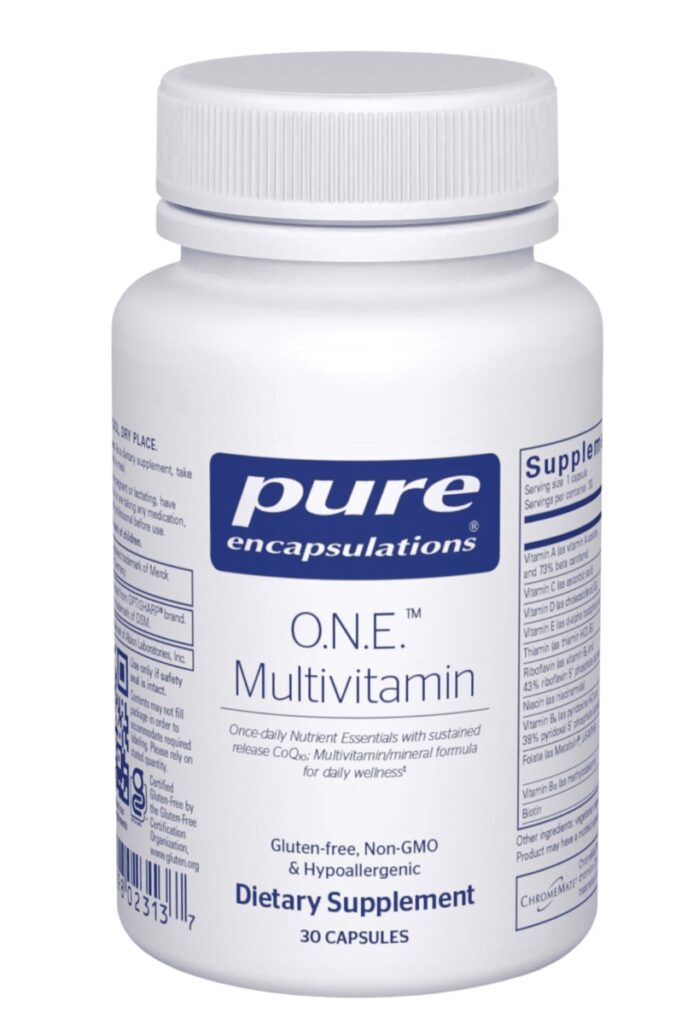
- Pure Encapsulations Nutrient 950 with copper, no iron
- Nordic Berries Nordic Naturals gummy multivitamins for kids
Our team evaluated and selected all of these based on their formula, consistency, and quality.
If you’re looking for help selecting a multivitamin, figuring out what you need, or discussing how nutrition and the other foundations of health can help you stay healthier and happier, we’re happy to talk.
In fact, you can schedule a 15-minute “Meet the doc” appointment with members of our team to see if we’re a good fit! Already a patient? Schedule an appointment today and let’s talk vitamins, minerals, and nutrients.